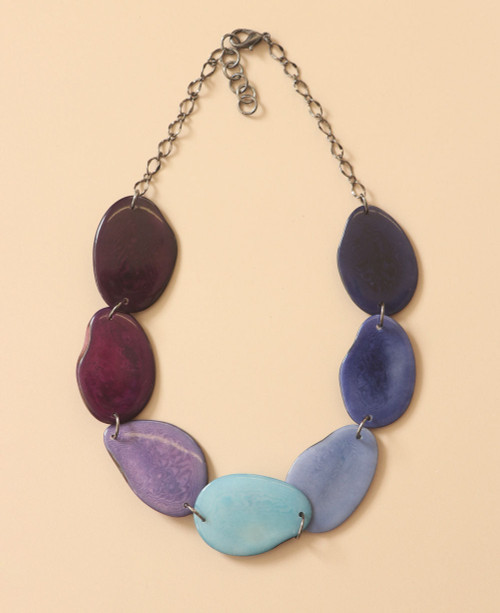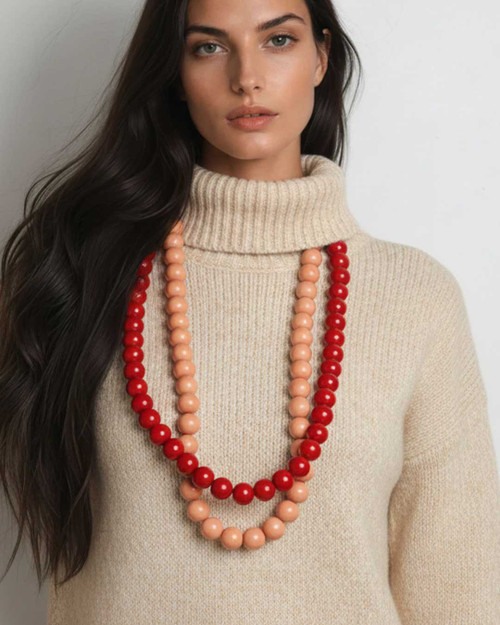


A bold design makes an equally bold design statement. Made from Tagua nuts, this statement necklace features a single 24K gold plated tagua pod that contrasts beautifully with the turquoise blue-toned tagua chunks.
- Made of Tagua nut
- Features a 24K gold-plated pod
- Adjustable length, up to 32 inches long
- Blue suede cord
- By women artisans in Colombia
- Fairtrade and handmade
design: A statement necklace of chunky, hand-polished tagua nut beads in a rich turquoise-blue, offset by a single dome-shaped tagua pod finished in 24K gold plating, all strung on a blue suede cord.
size: Adjustable, up to 32 inches long. Not specified beyond that.
material: Tagua nut (vegetable ivory), 24K gold plating on the accent pod, blue suede cord.
features: Adjustable up to 32 inches, single 24K gold-plated tagua pod accent, hand-dyed turquoise tagua beads, blue suede cord, hand-knotted between beads
care: Wipe clean with a soft, dry cloth and keep away from water, perfume, and lotion to protect the dye and gold plating.
disclaimer: Because each bead is cut and dyed from a natural tagua nut by hand, slight variations in shape, size, and color are normal and part of the piece's character.
The Story
Tagua is the seed of a palm native to the rainforests of Colombia and Ecuador. Once dried, it hardens to a dense, ivory-like material that has long been carved and worked as a substitute for animal ivory, giving it the nickname "vegetable ivory." Harvesting tagua sustainably supports rainforest communities by making standing palms more valuable than cleared land, tying the craft directly to conservation.
This necklace uses tagua in its most direct form: large, naturally irregular nut chunks, dyed a saturated turquoise blue and left unpolished into perfect uniformity so the material's organic character stays visible. The single gold-plated pod breaks the pattern deliberately, a common device in Colombian tagua jewelry where one or two accent beads are gilded to catch light against a field of color.
Stringing beads on cord rather than wire or chain, with the length left adjustable, reflects a practical, low-waste approach to jewelry-making common among artisan cooperatives working with natural materials — each nut is a different size, so the piece is built around the beads on hand rather than a fixed template.
Women artisans in Colombia hand-select dried tagua nuts, slice and shape each one, then dye the beads in small batches to reach an even, saturated color that still allows the nut's natural grain to show through. One bead per necklace is set aside for gold plating, a separate finishing step, before every piece is hand-strung and knotted on suede cord — knot by knot, so beads sit securely and the necklace keeps its adjustable drape.
Craft & Materials
- Made In: Colombia
- Craft Tradition: Tagua nut carving and dyeing (vegetable ivory)
- Ideal For: Someone who wants a bold, colorful statement piece with a sustainable, handmade story
- Wear It With: Let it anchor a simple neckline — a plain white tee, tank, or solid-color dress — so the color and scale take center stage
- Purpose: Statement necklace, everyday bold accessory, gift for a fair-trade or sustainable-fashion lover
- Metal: 24K gold plating (accent pod only; base material is tagua nut, not metal)
Questions & Answers
What is tagua, and is it real ivory?
No — tagua is a plant seed from a palm native to Colombia and Ecuador, sometimes called "vegetable ivory" because it hardens to a dense, ivory-like texture once dried. No animal material is used.
How long is the necklace?
It's adjustable, with a maximum length of up to 32 inches, so you can wear it long or shortened to sit closer to the collarbone.
Will the color or gold plating wear off?
With normal care — keeping it away from water, perfume, and lotion, and wiping it clean with a dry cloth — the dye and plating will hold up well, though all plating can dull gradually with heavy wear.
Why do the beads look slightly different from each other?
Each bead is cut from a natural tagua nut and dyed and shaped by hand, so slight differences in size, shape, and tone are expected — they're a sign of the handmade process, not a flaw.
Who makes this necklace?
It's handcrafted by women artisans in Colombia through fair-trade production, meaning the makers are paid fairly for their work and skill.