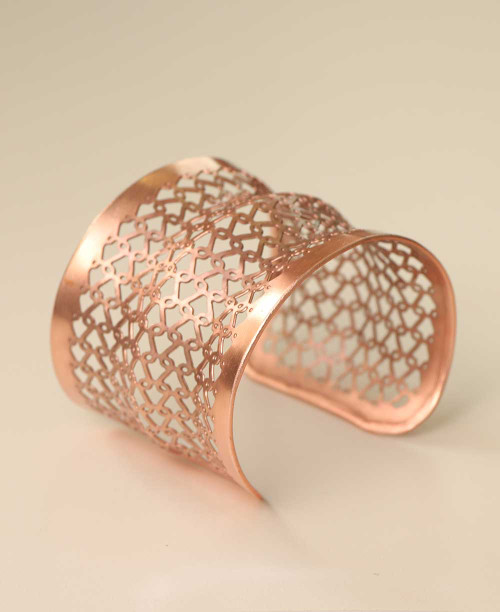


This wide cuff bracelet in a silver-tone finish showcases an intricate geometric lattice pattern, offering a sophisticated and timeless look. Its adjustable fit ensures comfort, making it a perfect statement piece for any occasion.
- Features a detailed geometric lattice design for a modern and refined aesthetic.
- Made from brass with a silver-tone finish and ecoating for added shine and durability.
- Dimensions: 6.5" circumference and 2.25" wide, providing a bold and elegant fit.
- Handcrafted by artisans in India, combining traditional craftsmanship with contemporary style.
- Adjustable fit, designed for versatility and comfort.
design: A wide, open cuff bracelet in a bright silver-tone finish, its surface cut through with a dense geometric lattice pattern that lets light pass through like a screen.
size: 6.5" circumference, 2.25" wide, adjustable open cuff.
material: Brass with a silver-tone plated finish and protective e-coating.
features: Pierced geometric lattice pattern, wide cuff silhouette, adjustable open-back fit, silver-tone plating for shine and tarnish resistance
care: Wipe with a soft, dry cloth after wear and store away from moisture to keep the plated finish bright.
disclaimer: As a handcrafted piece, slight variations in the cutwork and finish are normal and part of its handmade character.
The Story
The bracelet's surface is built from a dense, repeating lattice of cut openwork — small linked geometric units that read almost like woven wire from a distance but are in fact pierced directly into the metal. This kind of pierced, screen-like patterning has deep roots in Indian design, most familiar from jali: the perforated stone and metal screens used for centuries in Indian architecture to filter light, air, and view while creating intricate, repeating geometry.
Translating that pierced-screen logic into wearable metal is a natural extension of the craft — the same principle of taking away material to create pattern and light, scaled down from a window screen to a cuff. The result is a piece that carries weight and presence on the wrist while staying visually light, since the openwork keeps it from ever looking solid or heavy.
Geometric lattice motifs like this one are prized in Indian metalwork precisely because they reward close looking: the pattern holds together as a whole from a distance, but breaks into individual cut units up close, a hallmark of pierced-metal traditions practiced by artisans across India.
A piece like this begins as a flat sheet of brass, into which the lattice pattern is cut by hand or with hand-guided tooling, unit by unit, until the design reads consistently across the whole surface. The cut sheet is then shaped around a form to curve into the open cuff, with the artisan working the metal until the proportions sit evenly. Edges are filed and smoothed, then the piece is plated to its silver-tone finish and sealed with a protective coating before a final polish.
Craft & Materials
- Made In: India
- Craft Tradition: Pierced lattice metalwork
- Ideal For: Someone who wants a bold, architectural statement piece for their wrist
- Wear It With: Wear alone on a bare wrist to let the lattice pattern stand out, or stack with slim bangles on the opposite arm.
- Purpose: Everyday statement wear, dressing up a simple outfit, gifting
- Metal: Brass with silver-tone finish
Questions & Answers
Is this bracelet real silver?
No — it's brass with a silver-tone plated finish and a protective e-coating, giving it the bright look of silver at a more accessible price.
Will it fit my wrist?
Yes. It's an open, adjustable cuff with a 6.5" circumference that can be gently flexed wider or narrower to fit most wrists.
How wide is the cuff?
It measures 2.25" wide, making it a substantial, statement-sized piece rather than a slim bangle.
Will the finish tarnish or wear off?
The e-coating is designed to protect the silver-tone plating and slow tarnishing, but like any plated finish it will last longest if kept dry and wiped clean after wear.
How should I adjust it to fit?
Gently open or close the cuff at the gap with both hands, adjusting gradually rather than forcing it in one motion, which can help the piece keep its shape over time.