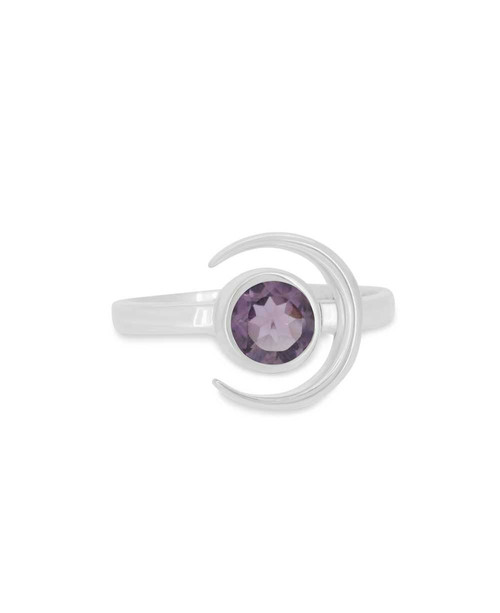
This sterling silver ring features a captivating labradorite gemstone, known for its mesmerizing play of colors and mystical energy. The labradorite is beautifully set within a crescent moon design, symbolizing intuition, transformation, and the magic of the night sky. The sleek band gracefully wraps around the stone and crescent, creating a unique and elegant design.
- Labradorite gemstone ring
- Sterling silver setting
- The ring crescent frame is 0.5" wide
- Sold individually, available in sizes 6 – 10
- Crescent moon design adds a layer of mystique and symbolism to the piece
- Labradorite is often associated with transformation, protection, and enhancing intuition.
Due to the nature of gemstone, each pendant may feature slight variations in gem color, details, and overall appearance.
design: A sleek sterling silver band opens into a crescent moon silhouette that curves around a round, bezel-set labradorite cabochon at its center.
size: Crescent frame measures 0.5" wide; ring available in sizes 6–10.
material: Sterling silver band and bezel setting with a natural labradorite gemstone.
features: Open crescent moon silhouette, round bezel-set labradorite cabochon, smooth polished band, sold individually
care: Wipe with a soft polishing cloth after wear and store away from moisture to keep the sterling silver from tarnishing.
disclaimer: Labradorite is a natural stone, so color flash, cloudiness, and pattern will vary slightly from ring to ring.
The Story
The crescent moon is one of the most widely used forms in jewelry design, appearing across countless cultures as a simple, graphic way to mark time, phase, and change. Here it's rendered as an open silver curve rather than a closed circle, letting the band itself become the shape instead of adding it as a separate charm.
Set at the crescent's open end, the labradorite cabochon reads almost like a sliver of night sky caught inside the metal. The stone's shifting blue-gray flash, known as labradorescence, comes from thin internal layers that bend and reflect light differently depending on the viewing angle — a genuine optical property of the mineral, not an added effect.
Pairing a lunar silhouette with a stone that visibly changes as it catches the light is a straightforward design logic: the setting simply echoes what the gem already does on its own.
A ring like this starts with a labradorite cabochon, cut and polished to bring out its play of color before it's ever set. The silver band and crescent are cast or hand-fabricated, then a bezel cup is soldered into place to hold the stone. A jeweler sets the cabochon into that cup and burnishes the metal edge down snug against the gem by hand, then files, sands, and polishes the whole piece so the crescent's curve stays clean and the silver finish is even across the band.
Craft & Materials
- Ideal For: Someone who wants an everyday ring with subtle celestial styling and a gemstone that changes with the light.
- Wear It With: Wear alone as a statement ring or stack with thin silver bands on adjacent fingers.
- Purpose: Everyday wear, gifting, stacking with other rings
- Gemstone: Labradorite
- Metal: Sterling Silver
Labradorite is best known for labradorescence, the flash of blue, gray, and sometimes green that moves across the stone's surface as it catches light. It's long been associated in gem lore with transformation and intuition, though what actually makes each stone distinctive is simply the mineral layering that produces its color play — no two cabochons flash quite the same way.
Questions & Answers
What sizes does this ring come in?
It's available in sizes 6 through 10, sold individually.
Will the color of my labradorite match the photo exactly?
Not exactly — labradorite is a natural stone, so color flash, tone, and pattern vary slightly piece to piece.
How do I keep the sterling silver from tarnishing?
Wipe it with a soft polishing cloth after wear and store it in a dry place, away from moisture and direct sunlight.
Can I wear this ring every day?
Yes, sterling silver and labradorite both hold up well to regular wear, though it's best to remove it before swimming or heavy manual work.
How is the labradorite held in place?
The cabochon sits in a hand-set bezel cup, with the silver edge burnished down snug against the stone.