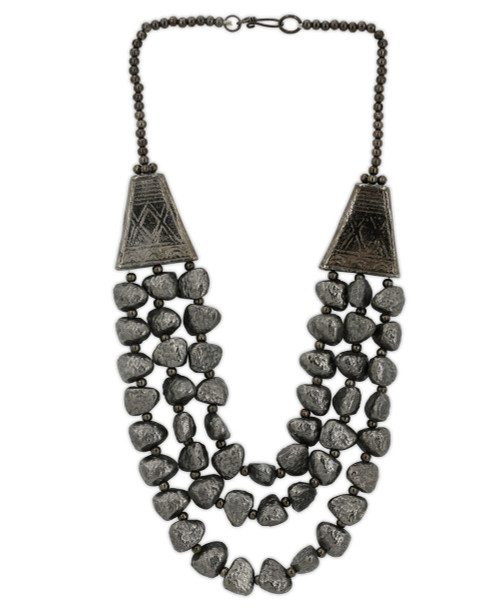
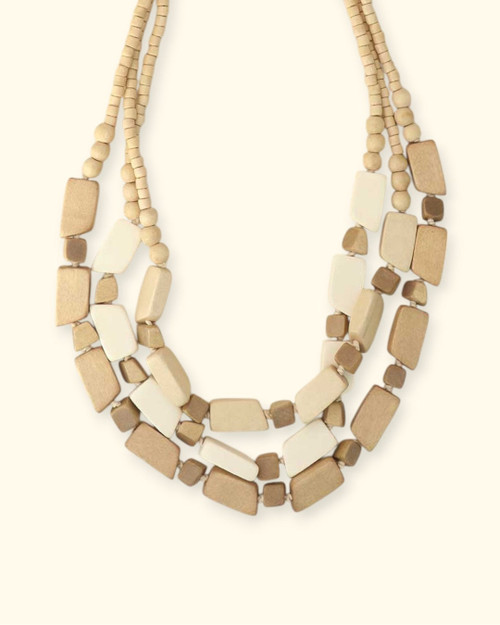
A three-strand statement necklace built around natural stone and vintage glass, blending soft gray magnesite tubes with sage-green serpentine and disc-cut black vulcanite. Each strand is hand-strung in the USA, balancing weight and color across the length.
- Material: Magnesite, serpentine, black vulcanite, glass beads
- Size: 21" Plus 3" extender
- Details: Triple-strand construction with cylindrical magnesite at the top, warm rust-toned glass accents, stacked vulcanite discs, and rounded serpentine beads finishing the drop
- Origin / Craft: Hand-assembled in the USA
The graduated bead sizes give the piece a sculptural drape, while the segmented color blocks — pale gray to rust to charcoal to sage — read like a study in earthy contrast. Gold-tone end caps and a lobster clasp with extender chain keep the closure clean and adjustable.
Care: Wipe stones with a dry soft cloth and store flat to preserve strand tension.
design: A three-strand statement necklace that graduates from pale gray cylindrical magnesite tubes, through a band of warm rust-toned glass and stacked black vulcanite discs, into rounded sage-green serpentine beads at the drop.
size: 21 inches, plus a 3-inch extender chain (adjustable up to approximately 24 inches).
material: Magnesite, serpentine, black vulcanite, and glass beads, strung on gold-tone metal findings.
features: Triple-strand construction, graduated bead sizes for a sculptural drape, color-blocked segments moving from gray to rust to charcoal to sage, gold-tone end caps, lobster clasp with 3-inch extender chain
care: Wipe the beads with a dry, soft cloth and store the necklace flat to keep the strands from tangling or losing tension.
disclaimer: Because the magnesite and serpentine are cut from natural stone, expect slight variation in color, veining, and shape from strand to strand.
The Story
Multi-strand beaded necklaces built around graduated, color-blocked segments are a long-standing form in American beadwork, where stringers plan a piece the way a painter blocks in color fields: soft neutrals at the shoulder, a band of contrast at the collarbone, and a heavier, saturated drop at the center front. Here that logic plays out across three strands at once, so the necklace has to be strung with the color transitions lined up evenly, strand to strand.
The materials carry their own quiet history. Magnesite is a soft, porous mineral often cut into simple geometric shapes like the tubes used here; serpentine takes its name from its mottled, snakeskin-like surface and has been worked into beads for centuries wherever it's found, prized less for rarity than for its consistent, earthy color. Black vulcanite — hardened, dyed rubber compound — became a popular stand-in for jet and other dark stones in costume and statement jewelry through the 20th century, valued for being lightweight against the neck.
Together they read as a study in earthy contrast rather than any single motif: gray, rust, charcoal, and sage laid out in deliberate blocks, finished with a simple gold-tone clasp so the beadwork itself stays the focus.
A piece like this starts with sorting: matching magnesite tubes, glass rounds, vulcanite discs, and serpentine beads by size and shade so the three strands read as one balanced composition rather than three mismatched ropes. The stringer works each strand by hand, checking the color transitions against each other as they go, then knots and caps the ends before attaching the clasp and extender. It's hand-strung in the USA, and getting the drape right — enough tension to hold shape, enough give to sit naturally at the collarbone — is a matter of feel built up over repetition.
Craft & Materials
- Made In: United States
- Craft Tradition: Hand-strung beadwork
- Ideal For: Someone who wants a bold, textural statement necklace that pairs easily with simple tops
- Wear It With: Let it anchor a solid-color crewneck, wrap top, or simple dress — the color-blocked strands do the talking
- Purpose: Everyday statement wear, dressing up a simple outfit, gifting
- Gemstone: Magnesite, Serpentine
- Metal: Gold-tone metal (end caps and lobster clasp)
Magnesite is a soft white-to-gray mineral, often left in its natural pale tone (as it is here) or dyed to mimic turquoise; its appeal is its smooth, matte surface and consistency across cut beads. Serpentine gets its name from its mottled green surface, reminiscent of snakeskin, and has been used in beadwork and carving across many cultures simply because it's workable, widely available, and holds a steady earthy green that pairs easily with other natural materials.
Questions & Answers
How long is this necklace?
It measures 21 inches with an additional 3-inch extender chain, so it can be worn anywhere from 21 to about 24 inches.
Are the stones dyed or natural?
The magnesite and serpentine are natural stone, so expect gentle variation in shade and pattern from bead to bead; the black vulcanite is a dyed hardened-rubber material, and the rust-toned accents are glass.
Is it heavy to wear?
The three strands add visual weight, but the beads are lightweight materials (stone, glass, and vulcanite rather than dense metal), so it sits comfortably for a statement piece of this size.
Where is it made?
It's hand-strung in the USA.
How should I clean and store it?
Wipe the beads with a dry, soft cloth after wear and lay the necklace flat in storage to keep the strands from tangling or stretching unevenly.