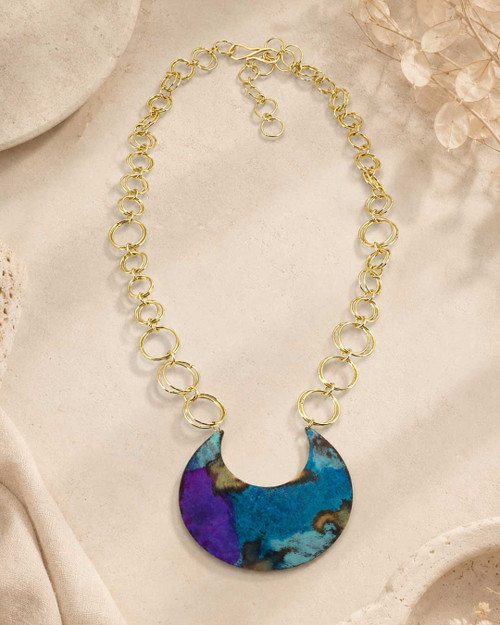
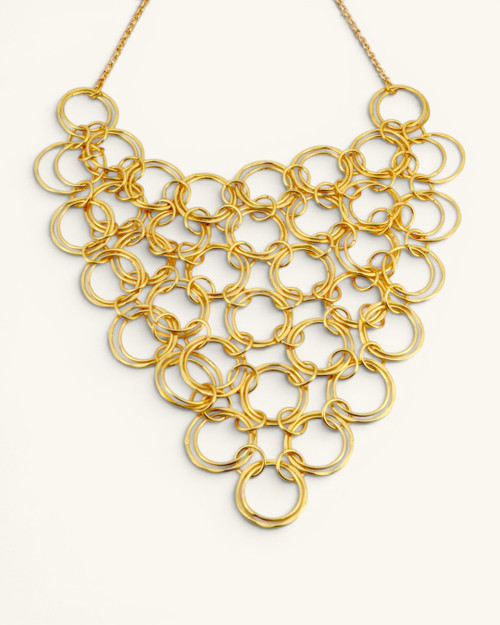
Two brass rings — one hammered flat, one cylindrical — orbit at the center of an open collar, held by a single loop of raw wire. Forged by metalsmiths in India, the piece is a study in line, weight, and negative space.
- Material: Brass / Copper / Bronze metalwork
- Size: Cir 17.25"
- Details: Open-ended adjustable collar bar; two concentric ring pendants suspended on raw wire
- Origin / Craft: Hand-forged in India
The collar curves into a slim torque that slips on from the back, leaving the neckline uninterrupted. Two graduated rings hang in casual asymmetry at the front — the inner band catches light along its flattened plane while the outer ring traces a clean wire arc. Tool marks along the hammered band reveal the hand of the maker rather than a polished factory finish.
Care: Wipe with a soft, dry cloth and store flat to keep the collar's shape.
design: An open brass collar in a slim torque shape holds two concentric ring pendants at center — one ring hammered into a flat, light-catching band, the other left as a rounded wire arc, joined by a single loop of raw wire.
size: Cir 17.25"
material: Brass, hand-forged from wire and sheet stock (sourcing data notes a brass/copper/bronze metalwork blend).
features: Open-ended adjustable collar bar, two concentric ring pendants in graduated sizes, one flat-hammered ring and one round wire ring, visible hammer and tool marks, raw wire jump loops
care: Wipe with a soft, dry cloth and store flat to help the collar hold its shape.
disclaimer: Because each collar is hand-forged and hammered individually, slight variations in curve, ring alignment, and surface marking are normal and part of its handmade character.
The Story
The collar, or torque, is one of the oldest jewelry forms there is: a rigid open band that slips on from the back and sits close to the neck without a clasp. This piece takes that ancient structure and pares it down to essentials — a single curved bar and two hanging rings — so the design reads as pure line and negative space rather than ornament layered onto it.
The two pendant rings do the real visual work. One is forged flat with a hammer, so its surface catches light along a defined plane; the other is left as a rounded wire arc, softer and more open. Hanging one inside the other, slightly off-center, gives the piece a sense of casual, hand-set asymmetry rather than mechanical precision — a signature of pieces built with hammer and anvil instead of a mold.
A piece like this starts as brass wire and flat stock, worked by a metalsmith at a hammer and stake rather than cast in a mold. The collar bar is bent into its open curve and the ends finished smooth so it sits comfortably at the neck. The flat ring pendant is hammered by hand until its band is true and even, while the second ring is shaped by bending wire into a closed arc. Raw wire is then coiled into small loops to link the two rings to the collar — a simple mechanical join that leaves the hammer marks and slight surface irregularities visible, evidence of the maker's hand at each step.
Craft & Materials
- Made In: India
- Craft Tradition: Hand-forged brass metalwork
- Ideal For: Someone drawn to minimalist, sculptural jewelry with visible handcraft
- Wear It With: Let it sit on its own over a crew neck, boat neck, or open collar shirt — the negative space is the point, so keep the rest of the neckline simple
- Purpose: Everyday statement wear, layering piece, gifting
- Metal: Brass
Questions & Answers
Is the collar adjustable?
The collar bar is open-ended and slips on from the back; its rigid brass shape holds a consistent fit rather than adjusting like a chain, with a total circumference of 17.25".
What is the necklace made of?
It's hand-forged brass, worked from wire and sheet stock by metalsmiths in India, with tool and hammer marks left visible as part of the finish.
Will the brass tarnish over time?
Brass can naturally darken with air and moisture exposure; a soft dry cloth will restore its shine, and storing it flat helps keep the collar's shape and finish.
Why do the two rings hang unevenly?
That asymmetry is intentional and comes from the hand-forging process — one ring is hammered flat, the other left as a rounded wire arc, and they're hung slightly off-center on purpose rather than aligned like a machined pair.
How should I store it?
Lay it flat rather than hanging it, so the open collar bar keeps its curve and the ring pendants don't bend out of shape.